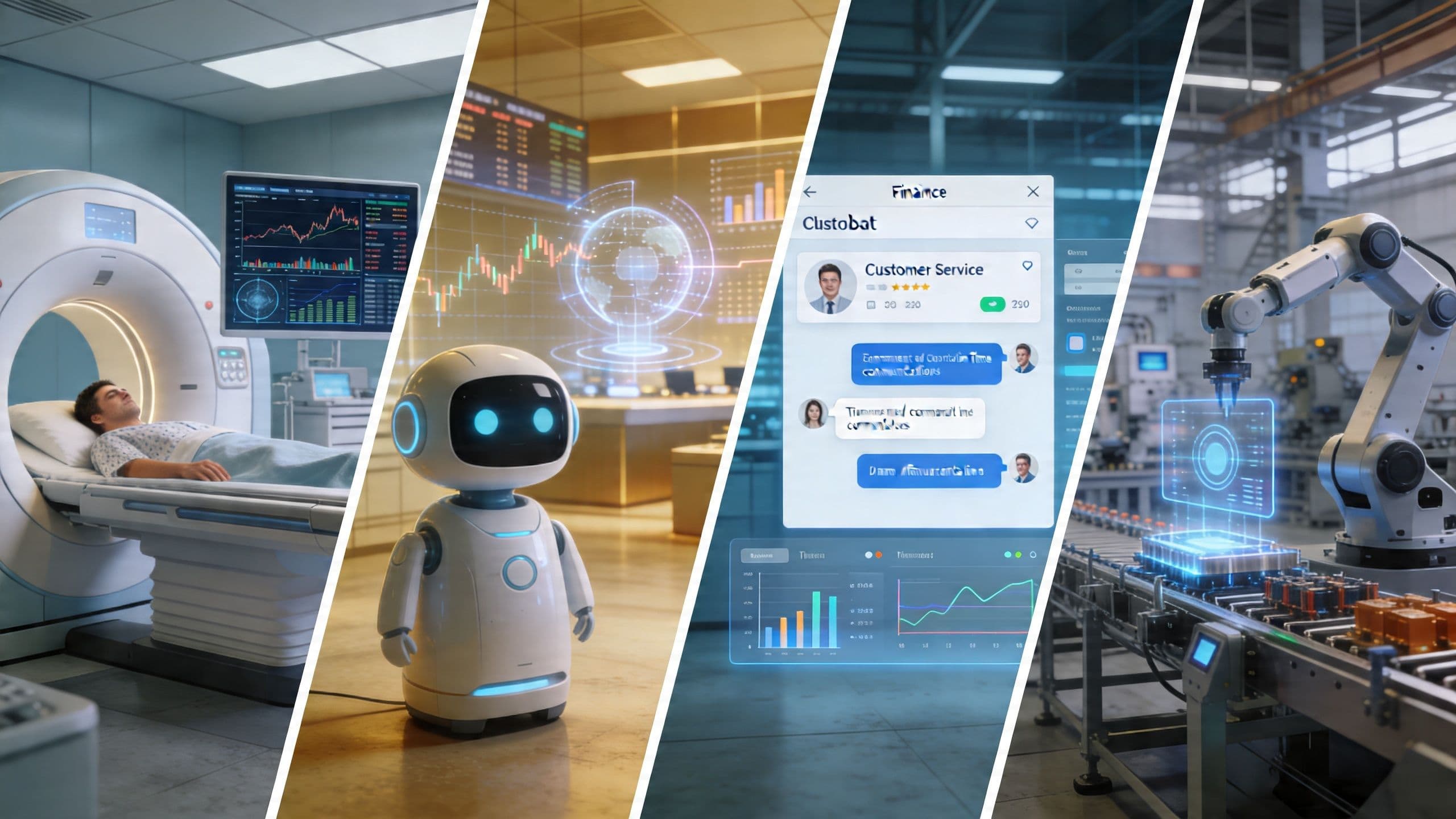
Unpacking Artificial Intelligence in Industry and Business: Practical Use Cases Transforming Work
Artificial Intelligence is reshaping industries by streamlining operations, enhancing decision-making, and unlocking new business opportunities. This article explores practical AI applications across sectors, highlighting how businesses leverage AI to drive efficiency and innovation.
Avery writes about trends, platforms, and strategic shifts in artificial intelligence, with attention to what matters in practice.

AI Driving Precision and Efficiency in Manufacturing
Manufacturing has been a foundational sector for AI adoption, primarily through predictive maintenance and quality control. AI algorithms analyze sensor data from production lines to predict equipment failures before they happen, reducing downtime and maintenance costs. For example, Siemens uses AI-powered monitoring systems that optimize factory workflows and detect anomalies in real time, leading to significant efficiency gains.
Additionally, AI-driven computer vision inspects products at a granular level, identifying defects far more reliably than human inspectors. Companies like General Electric deploy these systems to ensure consistent product quality while accelerating production speeds. By automating routine checks, manufacturers can reallocate human workers to higher-skill tasks.
Enhancing Customer Engagement and Operations in Retail
Retail is another sector where AI has become indispensable, particularly for personalizing customer experiences and streamlining supply chains. AI-powered recommendation engines, as used by Amazon and Walmart, analyze vast datasets on consumer behavior to suggest products tailored to individual preferences. This personalization boosts sales conversion rates and customer loyalty.
On the operational front, AI assists in demand forecasting and inventory management, minimizing both overstock and stockouts. Tools like IBM Watson Supply Chain harness AI to predict consumer demand fluctuations caused by seasonality or external factors, enabling retailers to optimize ordering and logistics.
Revolutionizing Financial Services with AI Analytics
The financial industry leverages AI primarily for risk assessment, fraud detection, and algorithmic trading. Banks and investment firms employ machine learning models to analyze transaction patterns in real time, flagging potentially fraudulent activities with high accuracy. For instance, JPMorgan Chase uses AI to detect credit card fraud attempts and improve compliance monitoring.
On the investment side, AI-driven platforms such as BlackRock’s Aladdin employ predictive analytics and natural language processing to analyze market data and news sentiment. This helps portfolio managers make more informed decisions, balancing risk and returns in dynamic markets.
Transforming Healthcare Through AI-powered Diagnostics and Patient Care
Healthcare is rapidly integrating AI to enhance diagnostics, personalize treatment, and automate administrative tasks. AI systems, trained on vast clinical datasets, can detect anomalies in medical imaging with accuracy rivaling expert radiologists. For example, Google Health's AI model assists in identifying breast cancer from mammograms earlier and more reliably.
Beyond imaging, AI-driven virtual assistants support patient interactions by handling routine inquiries and medication reminders, freeing clinicians to focus on complex cases. Moreover, AI optimizes hospital operations by predicting patient admission rates and resource needs, improving care efficiency.
Embracing AI Responsibly: Lessons and Pitfalls to Avoid
While AI offers transformative potential, businesses must navigate challenges to realize benefits fully. One common mistake is neglecting data quality — AI algorithms are only as effective as the data they are trained on. Inconsistent or biased data can lead to erroneous outcomes or perpetuate inequities.
Another pitfall involves underestimating the importance of human oversight. Fully autonomous AI systems may perform well in controlled scenarios but can falter in unpredictable environments. Industry leaders emphasize a hybrid approach, where AI supports human decision-making rather than replaces it entirely.
Finally, transparency and explainability are critical, especially in regulated sectors like finance and healthcare. Organizations should prioritize AI systems that offer insights into their decision processes to build trust among stakeholders and comply with regulatory requirements.
A Practical Path Forward for AI Adoption
To harness AI effectively, businesses should first identify operational pain points that AI can address pragmatically — be it reducing downtime, improving customer personalization, or automating routine tasks. Starting with pilot projects allows teams to evaluate impact and scalability before full deployment.
Cross-functional collaboration between AI experts, domain specialists, and business leaders is essential to align AI initiatives with strategic objectives. Staying informed about emerging tools and best practices will also help organizations adapt and innovate as AI technology evolves.
Ultimately, artificial intelligence in industry and business is not about flashy futuristic applications but practical solutions that optimize workflows, enhance insights, and create competitive advantage. Embracing AI thoughtfully and strategically paves the way for smarter, more resilient organizations poised for the future.
Safety & Scope
This article is for general informational purposes and does not replace professional advice for complex repairs or installations.
Frequently Asked Questions
+What should readers understand first about artificial intelligence Industry & Business use cases?
The foundational understanding is that AI is a practical tool designed to enhance efficiency, accuracy, and decision-making across industries. It's not about replacing humans but augmenting their capabilities with data-driven insights and automation tailored to specific business challenges.
+What are the most useful examples or use cases for artificial intelligence Industry & Business use cases?
Key use cases include predictive maintenance in manufacturing, personalized recommendations and supply chain optimization in retail, fraud detection and algorithmic trading in finance, and diagnostic assistance with patient management in healthcare. These applications demonstrate how AI delivers tangible operational improvements.
+What mistakes should I avoid with artificial intelligence Industry & Business use cases?
Avoid relying on poor quality or biased data, ignoring the need for human oversight, and deploying opaque AI systems without transparency. Missteps in these areas can lead to ineffective AI implementations, ethical concerns, and regulatory issues. Adopting a cautious, informed approach that prioritizes data integrity and explainability is crucial.